



ARTIST |
Cécilia Bracmort |
TITLE |
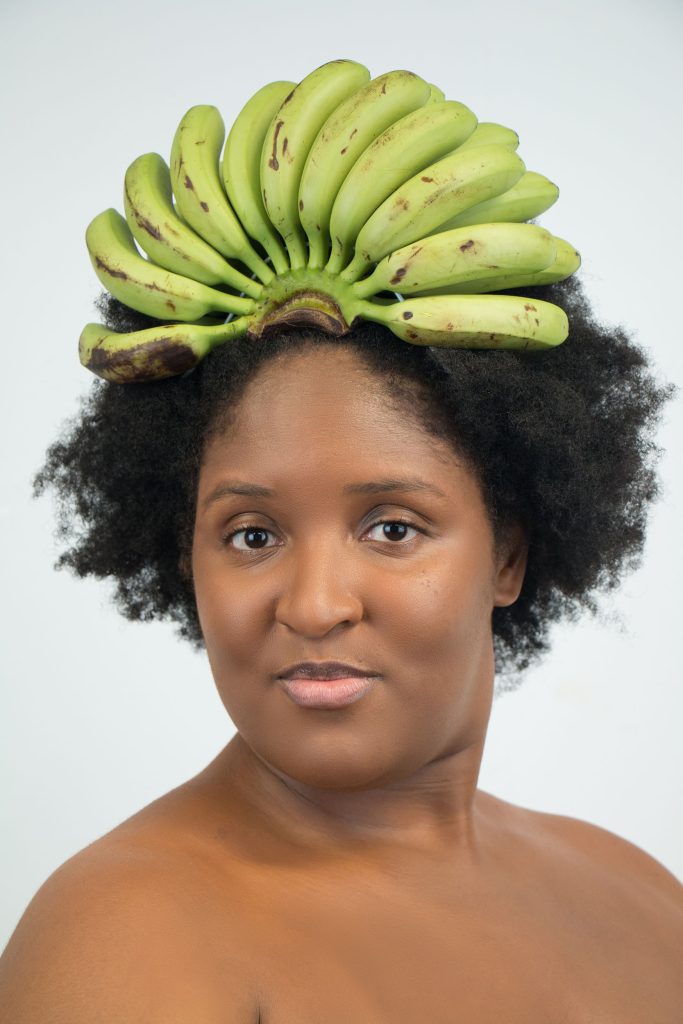
Sans titre, Banane III and Sans titre, Banane IV from the series Peau Nature Morte |
YEAR |
2021 |
ARTIST’S COUNTRY OF ORIGEN |
France, Canada, Martinique, Guadeloupe |
DIMENSIONS |
114 x 67 cm / 44.88 x 26.38 " |
MEDIUM |
Inkjet on paper |
Courtesy of the Artist
In Peau Nature Morte (2020), the banana is reconfigured as both sculptural form and conceptual device, encircling the artist’s head like an improvised crown. Still unripe, its green surface resists the chromatic codes of consumption, foregrounding instead a state of suspension—neither fully natural nor fully commodified. The fruit’s radial arrangement echoes botanical growth while simultaneously recalling the compositional strategies of classical still life, where abundance is staged as an aesthetic and economic display. Here, however, the banana does not rest passively on a table: it is elevated, worn, and activated in relation to the body.
This gesture destabilizes the historical function of the still life genre. Rather than presenting fruit as inert matter available for possession, the work insists on its entanglement with histories of extraction, circulation, and racialized labor. The banana—long emblematic of colonial economies and global trade—becomes inseparable from the artist’s own presence, producing a visual overlay between botanical skin and human skin. The slight bruising and imperfections visible on the peel further resist the idealized smoothness often associated with both commodity imagery and representations of the Black female body.
By positioning the banana as a mask-like extension of the self, the series exposes the mechanisms through which exoticism operates. The fruit, commonly coded as “tropical” and elsewhere-bound, mirrors the ways in which Black identity is projected as foreign within Western contexts. Yet its everyday ubiquity undermines this logic: like the banana, the artist’s body is both hyper-visible and normalized, desired and displaced. In Peau Nature Morte, the banana thus functions not only as symbol but as a critical interface through which questions of identity, circulation, and belonging are materially staged.
