
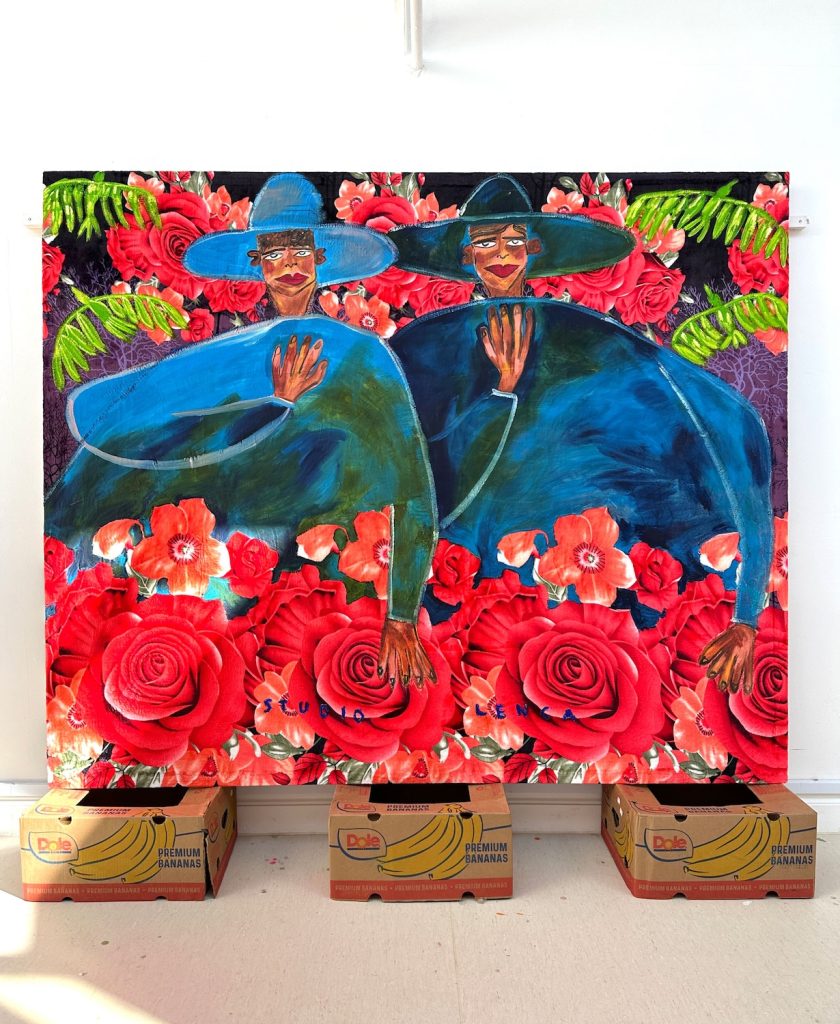


ARTIST |
Studio Lenca |
TITLE |
Cobija |
YEAR |
2023 |
ARTIST’S COUNTRY OF ORIGEN |
El salvador |
DIMENSIONS |
183 x 222 cm / 72.05 x 87.4 " |
MEDIUM |
Oil and acrylic on blanket |
Courtesy of the Artist. Acquired by The Pérez Art Museum, Miami, USA
Studio Lenca’s Cobija (2023) transforms the everyday materials of diaspora into a radiant affirmation of belonging. Painted on a vivid market-sourced blanket, the work combines oil and acrylic with a textile that itself carries layered histories of comfort, mobility, and migration. Two figures cloaked in blue, framed by lush red roses and tropical foliage, stand side by side in quiet solidarity. Beneath them, the word cobija—meaning both “blanket” and “shelter”—anchors the composition, signaling the work’s dual function as protection and testimony. The blanket’s tactile softness contrasts with the sharp geometries of gentrified London outside the studio, turning domestic fabric into an emblem of cultural endurance.
The materials of Cobija are deliberately humble yet profoundly symbolic. Found in Elephant and Castle Market, long a center for London’s Latinx communities, the cobija evokes the artist’s childhood in La Mission, San Francisco, and the transnational networks that connect Salvadoran diasporas to other Latin American and Caribbean contexts. The use of banana boxes as a base extends this metaphor: once vessels of commodity export from Central America, they here become the literal foundation supporting diasporic expression. By stacking these branded boxes under the painted blanket, Studio Lenca collapses economic and cultural geographies, exposing how colonial trade routes continue to underpin the circulation of both goods and people.
In Cobija, painting becomes an act of reclamation. Studio Lenca reconfigures the languages of commerce, migration, and visibility, asserting a diasporic presence too often erased from institutional narratives. The work’s exuberant color palette and monumental scale counter invisibility with joy and recognition, affirming that identity can be built from what has been discarded or overlooked. Both materially and conceptually, Cobija functions as a mobile monument to resilience—a shelter woven from the intertwined threads of memory, displacement, and collective imagination.
