


ARTIST |
Nash Caldera |
TITLE |
Untitled (Shango and the Journey) |
YEAR |
2021 |
ARTIST’S COUNTRY OF ORIGEN |
Curaçao |
DIMENSIONS |
138 x 115 cm / 54.33 x 45.28 " |
MEDIUM |
Tapestry, Textile collage |
Courtesy of the Artist
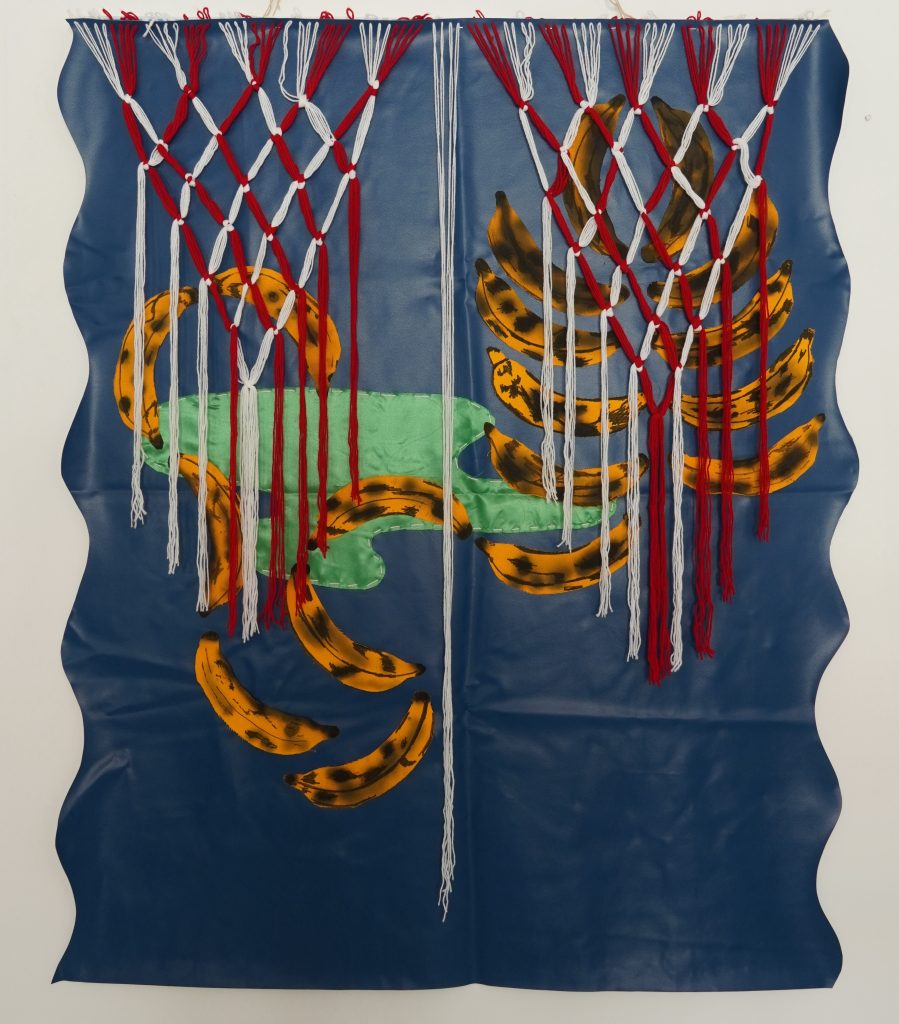
In this Untitled tapestry, Nash Caldera expands her ongoing exploration of the plantain as a diasporic connector, using textile collage to map the fruit’s long and entangled journey across continents. The plantain’s rhizomatic logic—its corm generating new shoots even after the original plant has died—becomes a metaphor for Afro-Caribbean cultural continuities that persist despite displacement and rupture. Layered onto a blue, reflective textile ground, the curved silhouettes of bananas appear both suspended and anchored, suggesting the simultaneous rootedness and mobility that define the histories of Curaçao, South America, and the Caribbean.
A cascading network of red and white knotted threads overlays the composition, visually echoing ritual cords associated with Changó, a major deity in the Yoruba pantheon and an important figure within Santería or Regla de Ocha. By referencing Changó’s offerings—plantains among them—and alluding to popular cultural expressions such as Willy Chirino’s Mr. Don’t Touch the Banana, Caldera bridges ancestral West African traditions with their Caribbean transformations. The tapestry thus becomes a site where spiritual lineage, material culture, and migration histories intersect, revealing the plantain as both a sacred object and a witness to transatlantic crossings, from Southeast Asia and Africa to the Americas.
Color plays a critical role in articulating the work’s layered identities. The sharp red–white–blue of the knotted cords evokes the Dutch flag, a reminder of the colonial framework that shaped life in Curaçao, while the yellow, blue, and white elements nod to Curaçao’s national colors. Created during the residency “(Plant-in)-Different-Soil” in the Netherlands, the tapestry registers Caldera’s own negotiation between colonial memory and Caribbean belonging. By weaving together symbols from across geographies and belief systems, she creates a textile landscape that holds the tensions, inheritances, and creative resilience that emerge when identities are cultivated across different soils.
