


ARTIST |
Moises Barrios |
TITLE |
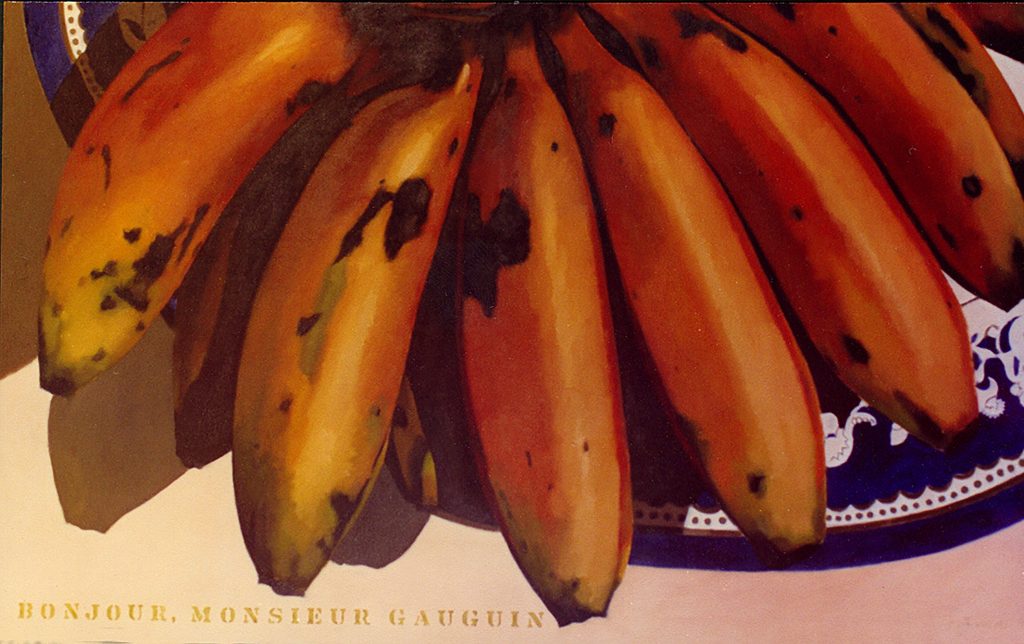
Bonjour, Monsieur Gauguin |
YEAR |
2001 |
ARTIST’S COUNTRY OF ORIGEN |
Guatemala |
DIMENSIONS |
140 x 110 cm / 55.12 x 43.31 " |
MEDIUM |
Oil on canvas |
Courtesy of the artist
In Bonjour, Monsieur Gauguin (2001), Moisés Barrios stages an encounter between colonial art history and the tropical commodity that came to define Central America’s visual and economic landscape. Against a softly modulated background, a radiant bunch of bananas rests on a patterned tray, while a small inscription—“Bonjour, Monsieur Gauguin”—runs quietly along the lower edge. The composition echoes the chromatic range of Gauguin’s Tahitian palette—ochres, blues, greens, and yellows—but turns its gaze away from the exoticized body toward the fruit itself, which here assumes the role of subject, symbol, and interlocutor.
Barrios’s title draws a line of correspondence with two canonical self-portraits in the history of modern painting: Gustave Courbet’s Bonjour, Monsieur Courbet and Gauguin’s Bonjour, Monsieur Gauguin. Both works stage a performative exchange between artist and society—the “wandering Jew” and the bourgeois citizen, the misunderstood genius and his world. In Barrios’s version, the exchange collapses. There are no figures, no dialogue—only the banana bunch, an emblem of displacement and commodification, silently occupying the space once reserved for the artist’s self.
By replacing the human protagonist with the tropical fruit, Barrios inserts the banana into the lineage of Western self-representation, transforming it into a metonym for colonial desire and economic exploitation. The painting becomes both homage and critique: a tropical still life that exposes the power dynamics embedded in modernism’s visual grammar. Where Gauguin’s gaze once sought the “primitive,” Barrios returns the gaze through the very object that sustained imperial fantasies—a reminder that the banana, too, has a history, a geography, and a politics of looking.
