


ARTIST |
Alexia Benavent-Rivera |
TITLE |
Peels so Good (circa 1944) |
YEAR |
2024 |
ARTIST’S COUNTRY OF ORIGEN |
Puerto Rico, Panama, Ukraine |
DIMENSIONS |
60.96 x 91.44 cm / 24 x 36 " |
MEDIUM |
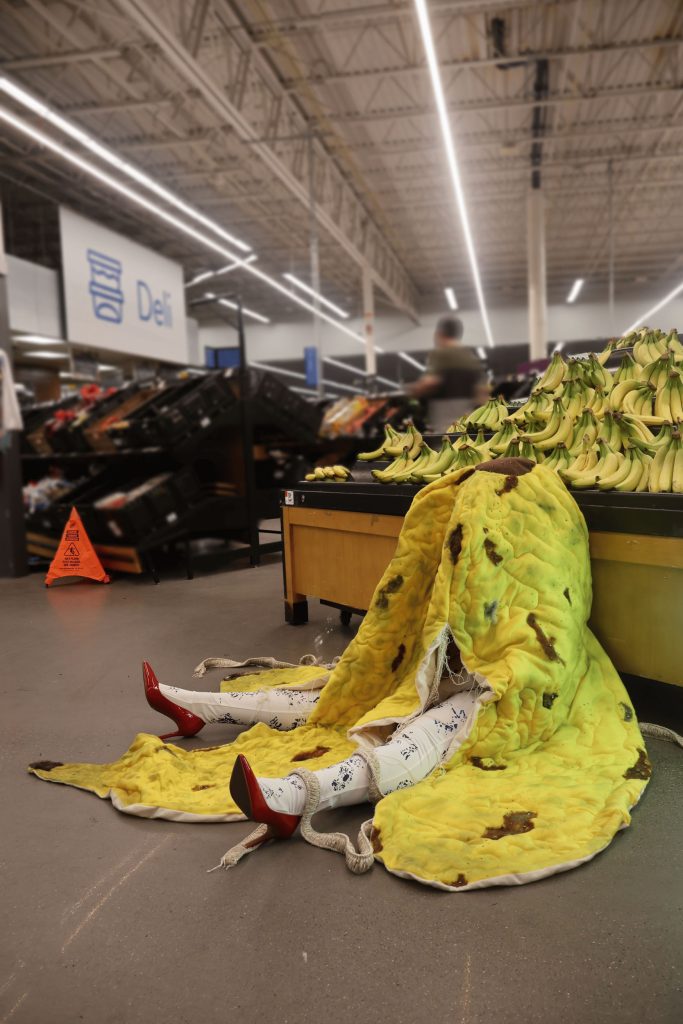
Photo of wearable with textile, beading, iron on vinyl, and felting |
Courtesy of the artist. Photo credit: Ysabel Flores, Hannah Glaser. Edited by: Alexia Benavent-Rivera
Alexia Benavent-Rivera’s Peels so Good (circa 1944) (2024) offers a biting parody of the banana’s dual status as seductive commodity and instrument of imperial control. The work takes the form of a wearable sculpture—crafted from fleece, flannel, beads, felt, and iron-on vinyl—photographed in the aisles of Walmart and Publix, transforming the supermarket itself into a stage for performance. The garment resembles a decaying banana peel: the bright, market-ready fruit has been stripped away, leaving behind a rotting shell. From this hollowed exterior emerges a layer of frogs, a stand-in for the people whose lives and labor animated the economies of the so-called “banana republics,” even as their voices were silenced.
The title alludes to the playful advertising strategies of the Chiquita Banana brand, particularly its mid-20th-century campaigns that sexualized Latin American women and framed them as exotic icons for North American consumers. Benavent-Rivera’s costume echoes the coquettish poses of those ads, but with grotesque distortion: the wearer inhabits the position of the Chiquita girl, yet instead of vibrancy and abundance, the performance highlights decay, rot, and the persistence of life in unexpected forms. The frogs—emblems of resilience, transformation, and collective survival—replace the missing flesh of the fruit, embodying the people who have endured the structural violence of corporate imperialism.
By inserting this irreverent, hand-stitched parody into the glossy space of the produce aisle, Peels so Good unsettles the everyday act of food shopping. It exposes the histories of corruption, dispossession, and gendered exoticism that continue to cling to the banana’s image. At once humorous and unsettling, the work collapses the gap between consumer fantasy and political reality, reminding viewers that even the most ordinary fruit carries the aftertaste of empire.
