


ARTIST |
Luis Gutierrez |
TITLE |
Lo Invisible, Una Fruta Tropical |
YEAR |
2024 |
ARTIST’S COUNTRY OF ORIGEN |
Colombia |
DIMENSIONS |
304.8 x 228.6 cm / 120 x 90 " |
MEDIUM |
Acrylic paint and ink on canvas |
Courtesy of the artist
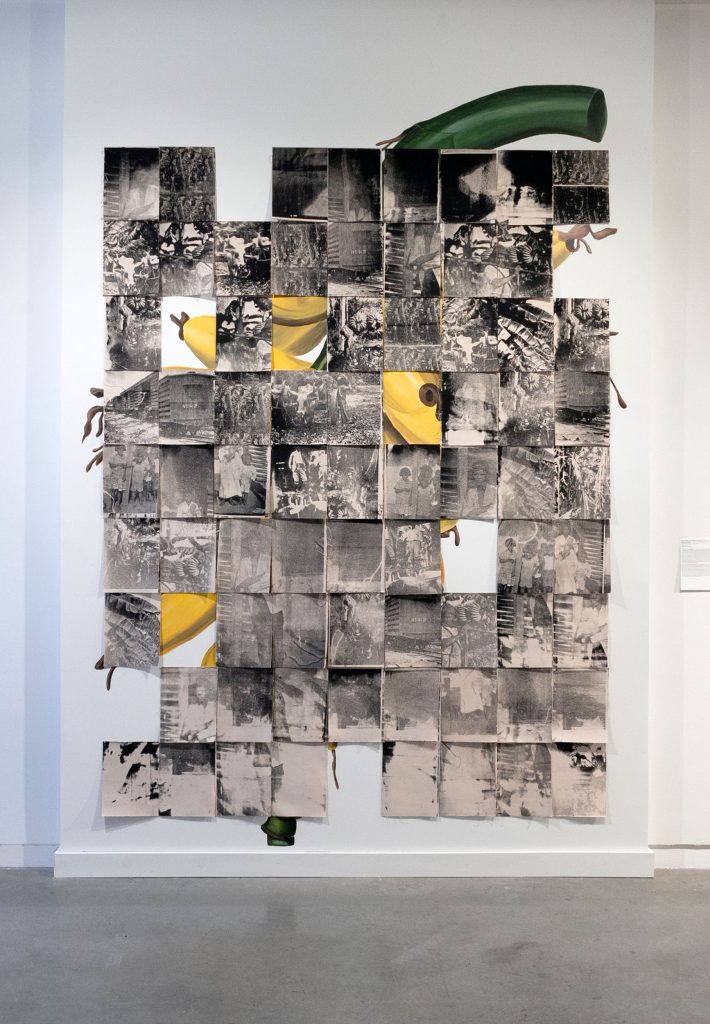
In Lo Invisible, Una Fruta Tropical (2024), Luis Gutiérrez layers botanical imagery with archival traces to uncover the obscured histories of labor, violence, and resistance surrounding the 1928 banana workers’ strike in Colombia. The installation consists of a large grid of screen-printed canvases—each square holding fragments of historical photographs—superimposed on a painted banana bunch appropriated from Pierre-Joseph Redouté’s Les Liliacées. By merging a refined European botanical illustration with images of exploited laborers, Gutiérrez exposes a stark contrast between the aestheticized colonial gaze and the brutal economic structures that underpinned the banana industry in the early twentieth century.
The nine horizontal rows reference the nine specific demands articulated by banana workers before the Colombian Army, backed by U.S. interests and the United Fruit Company, opened fire on December 12, 1928—a massacre that has since become a watershed in Colombian labor and political history. The fragmented prints evoke the fragmentary nature of the surviving documentation of the strike: dispersed testimonies, censored reports, and memories that continue to be contested and yet remain foundational to collective memory in the Caribbean and coastal Colombia. Gutiérrez’s woven composition suggests the difficulty of piecing together a history repeatedly denied or minimized, while insisting on the visibility of those who fought for dignified working conditions.
By drawing on Redouté—an artist celebrated for cataloging global flora under European imperial patronage—Gutiérrez critiques the long-standing entanglement between scientific illustration, classification, and colonial expansion. In juxtaposing this polished, Enlightenment-era botanical vocabulary with the harsh realities of banana monoculture and U.S. corporate intervention, the installation reframes the banana not as a picturesque exotic fruit but as an object embedded in systems of extraction, violence, and resistance. Lo Invisible, Una Fruta Tropical ultimately asks viewers to reconsider what has been preserved, what has been erased, and how the aesthetics of nature can obscure or reveal the political histories they quietly contain.
