


ARTIST |
Sergio Allevato |
TITLE |
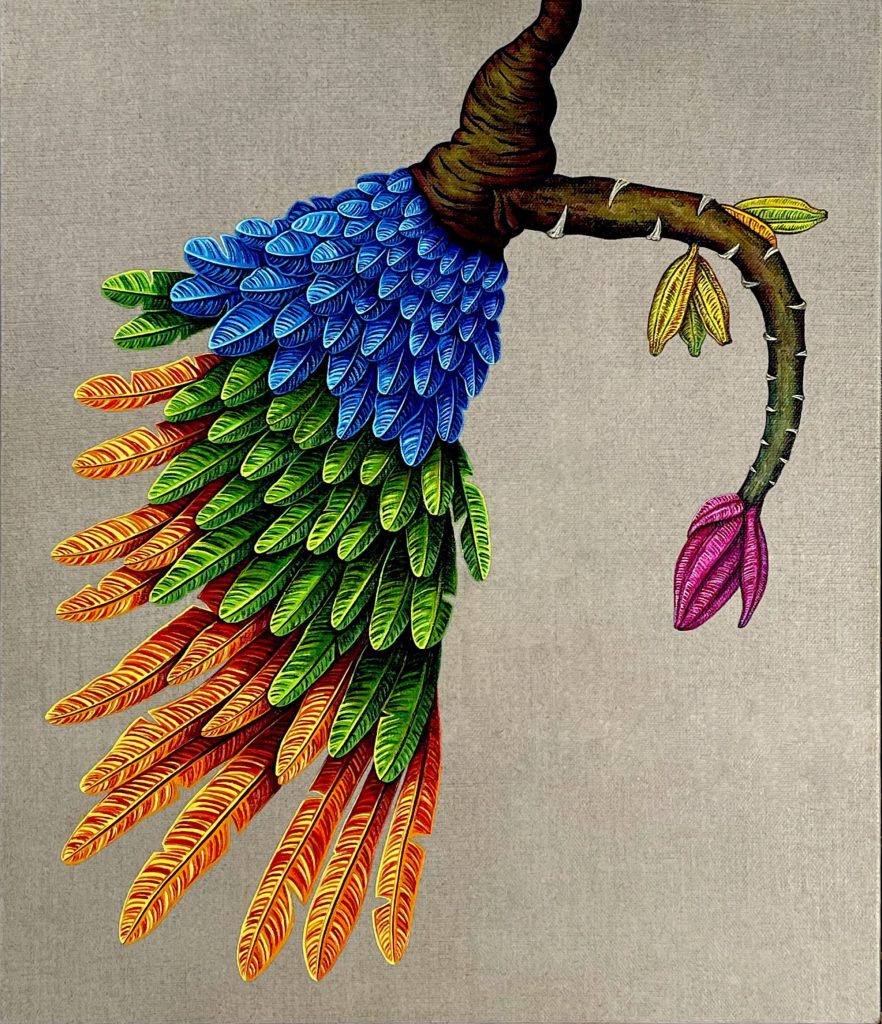
Muse, braZil series |
YEAR |
2024 |
ARTIST’S COUNTRY OF ORIGEN |
Brazil |
DIMENSIONS |
70 x 60 cm / 27.56 x 23.62 " |
MEDIUM |
Oil on linen |
Courtesy of the artist
Sergio Allevato’s Muse, braZil series (2024) fuses two enduring emblems of Brazil’s exotic imaginary—the banana and the parrot—into a single, hallucinatory organism. Emerging from a rough, thorned stem, the hybrid cluster resembles a bunch of bananas, yet its “fruits” are composed of layered feathers in iridescent blues, greens, and oranges, culminating in a magenta bloom. The work’s luminous precision, rendered in oil on linen, conjures both seduction and artifice: a tropical abundance so stylized that it verges on the uncanny. What seems natural reveals itself as a fiction—a fabricated muse assembled from centuries of projection and desire.
By merging these two colonial commodities, Allevato reveals how Brazil’s visual identity has been shaped by systems of extraction and fantasy. During the colonial period, parrots—prized for their ability to imitate human speech—were captured by the thousands and shipped to Europe as curiosities, their image surviving as shorthand for the tropics’ colorful promise. The banana, likewise, became a global symbol of fertility and pleasure, yet one bound to histories of plantation labor and exploitation. In Muse, these symbols intertwine, producing a “false fruit” whose beauty is inseparable from the violence that sustains it.
The work functions as both elegy and critique, dismantling the fantasy of a boundless, unspoiled tropic by exposing its constructed nature. Allevato’s meticulous brushwork mimics scientific illustration while subverting it, turning taxonomy into mythology. The hybrid banana-parrot form embodies Brazil’s condition as spectacle—desired, imitated, consumed—and reclaims it as a site of critical reflection. Muse, braZil series thus transforms the clichés of exoticism into a meditation on the persistence of colonial gazes and the resilience of cultural reinvention.
