


ARTIST |
Bryan Heredia |
TITLE |
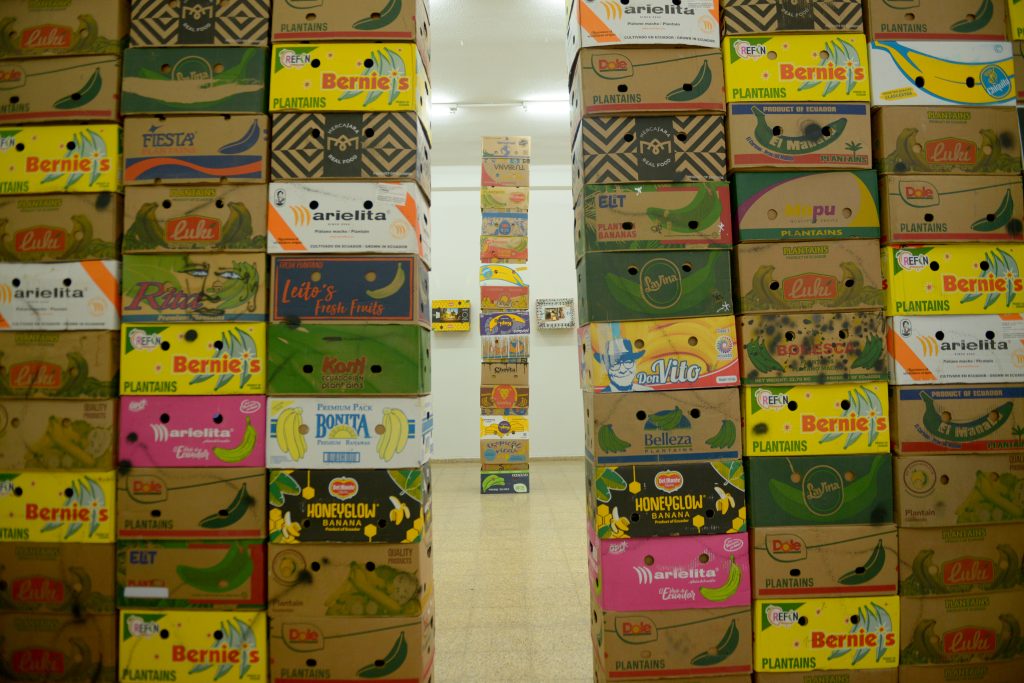
Trasfondo (proyecto de gran escala compuesto por las obras Banana Wall, Chimborazo dreams, Splash en la penitenciaría, Untitled – Cajas de luz, Tótem internacional, Teotihuacán amarillo y Mercamadrid) |
YEAR |
2025 |
ARTIST’S COUNTRY OF ORIGEN |
Ecuador |
DIMENSIONS |
Variables (Banana Wall: 360 x 450 x 50 cm / 141.73 x 177.17 x 19.69 ". Chimborazo dreams: 300 x 210 cm / 118.11 x 82.68 ". Splash en la penitenciaría: 240 x 210 cm / 94.49 x 82.68 ". Untitled – Cajas de luz: 200 x 40 x 25 cm / 78.74 x 15.75 x 9.84 ". Tótem internacional: 400 x 39 x 50 cm / 157.48 x 15.35 x 19.69 ". Teotihuacán amarillo: 240 x 280 cm / 94.49 x 110.24 ". Mercamadrid: 7’48’’) |
MEDIUM |
Mixed media installation (Banana Wal: 113 original banana boxes from Ecuador with spray paint and acrylic paintl; Chimborazo dreams: acrylic paint, permanent wax, marker, and airbrush on canvas; Splash en la penitenciaría: acrylic paint, permanent wax, marker, and airbrush on canvas; Untitled - Cajas de luz: 4 banana boxes from Ecuador with 35 mm analog photography and LED light.; Tótem internacional: 50 international banana boxes with enamel paint; Teotihuacán amarillo: banana box frame with Polaroid photography; Mercamadrid: color video) |
Courtesy of the artist
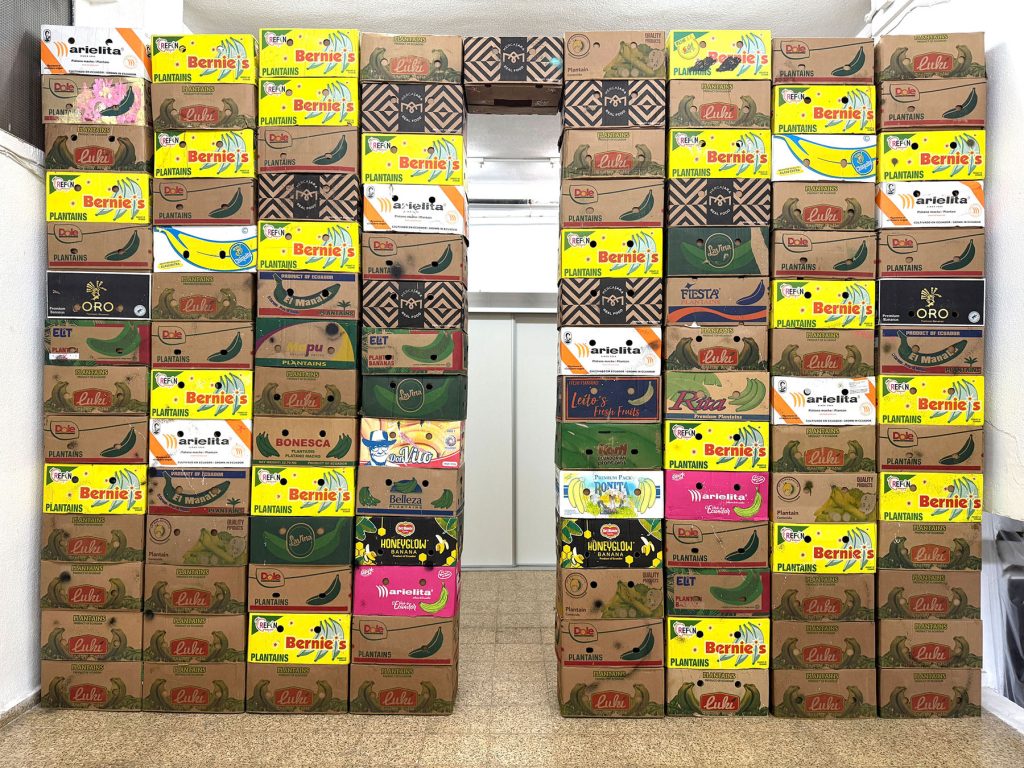
In Trasfondo (2025), Bryan Heredia transforms the exhibition space into a landscape constructed from real banana boxes used within global export circuits. Stacked into walls, columns, totems, and walkable corridors, the boxes cease to function as simple logistical containers and instead become an architecture of circulation and control. Their printed surfaces — saturated with logos, commercial names, idealized bananas, and export stamps — reveal the visual dimension of transnational trade, where graphic design, branding, and monoculture operate together as technologies of extraction. By reusing materials originating from Ecuador within a Spanish context, Heredia traces a historical continuity between Latin American banana economies and contemporary dynamics of global consumption, explicitly evoking the enduring legacy of the United Fruit Company and the corporate infrastructures that have shaped Ecuadorian territory since the mid-twentieth century.
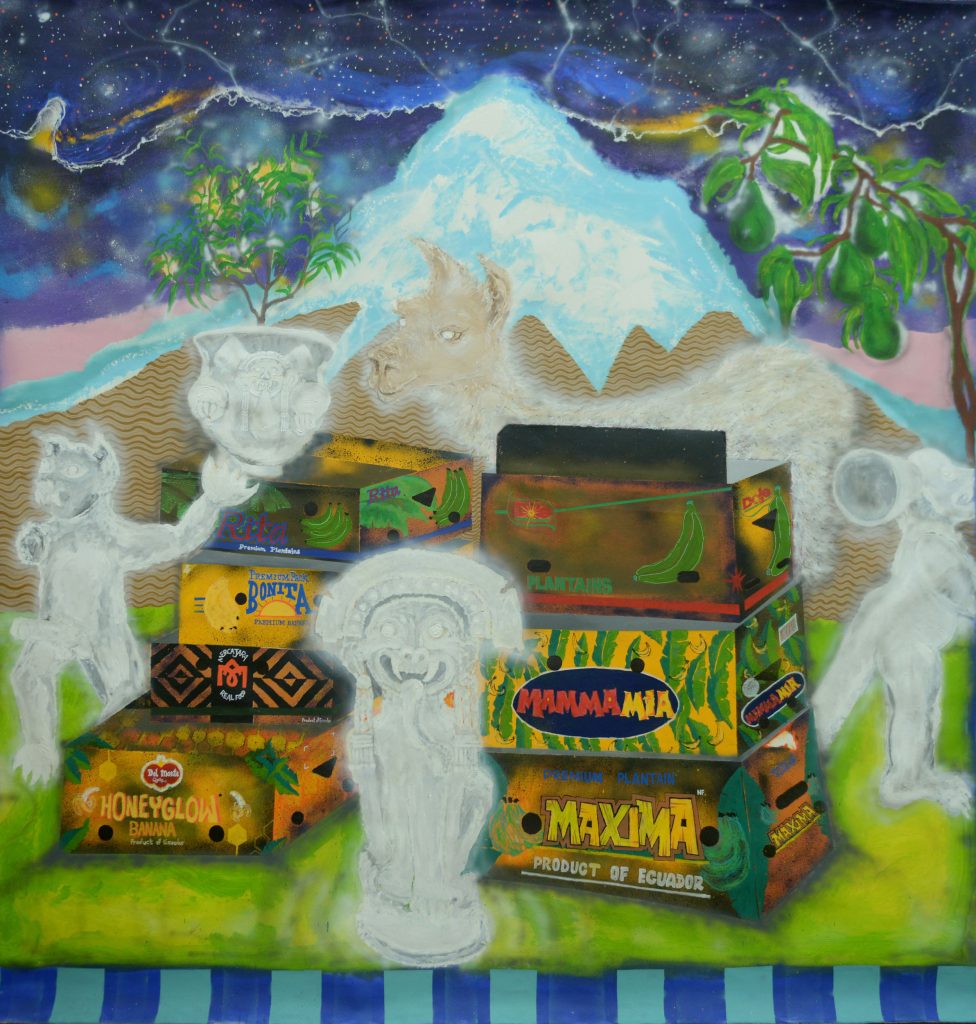
The installation unfolds as a fragmented visual vocabulary in which painting, photography, video, and sculpture function as extensions of a single system. In Banana Wall and Tótem internacional, the stacked boxes acquire a monumental scale that simultaneously recalls industrial warehouses, improvised borders, and contemporary ruins. The paintings Splash en la penitenciaría and Chimborazo dreams introduce ambiguous scenes where prison pools, Andean mountains, ghostly animals, and export boxes coexist within dreamlike yet violent atmospheres. Heredia thus juxtaposes imaginaries of tropical abundance with architectures of surveillance, confinement, and precarity, suggesting how commercial systems regulate not only commodities, but also bodies, mobility, and entire economies.
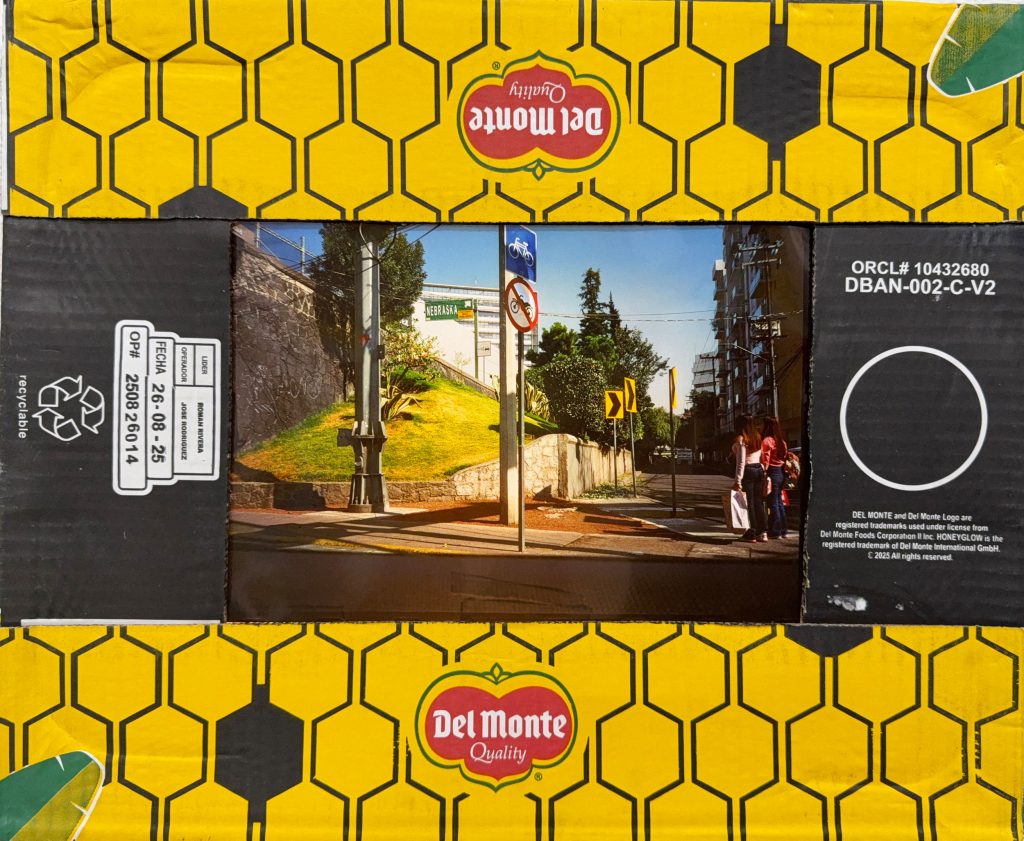
The photographic and audiovisual works further expand this reflection into an everyday and transnational dimension. The Cajas de luz incorporate analog photographs taken in Madrid, Mexico City, and New York into banana boxes illuminated from within, linking distant urban spaces through a shared material infrastructure of circulation. Likewise, the video Mercamadrid documents the invisible spaces of contemporary food distribution, where the constant movement of goods contrasts with the precarious conditions of those who inhabit such environments. Throughout Trasfondo, the banana appears less as a fruit than as a political device: an object capable of condensing histories of corporate colonialism, global mobility, labor exploitation, and economic violence within the seemingly banal surfaces of commercial packaging.
