


ARTIST |
Karen “Karne” Vera |
TITLE |
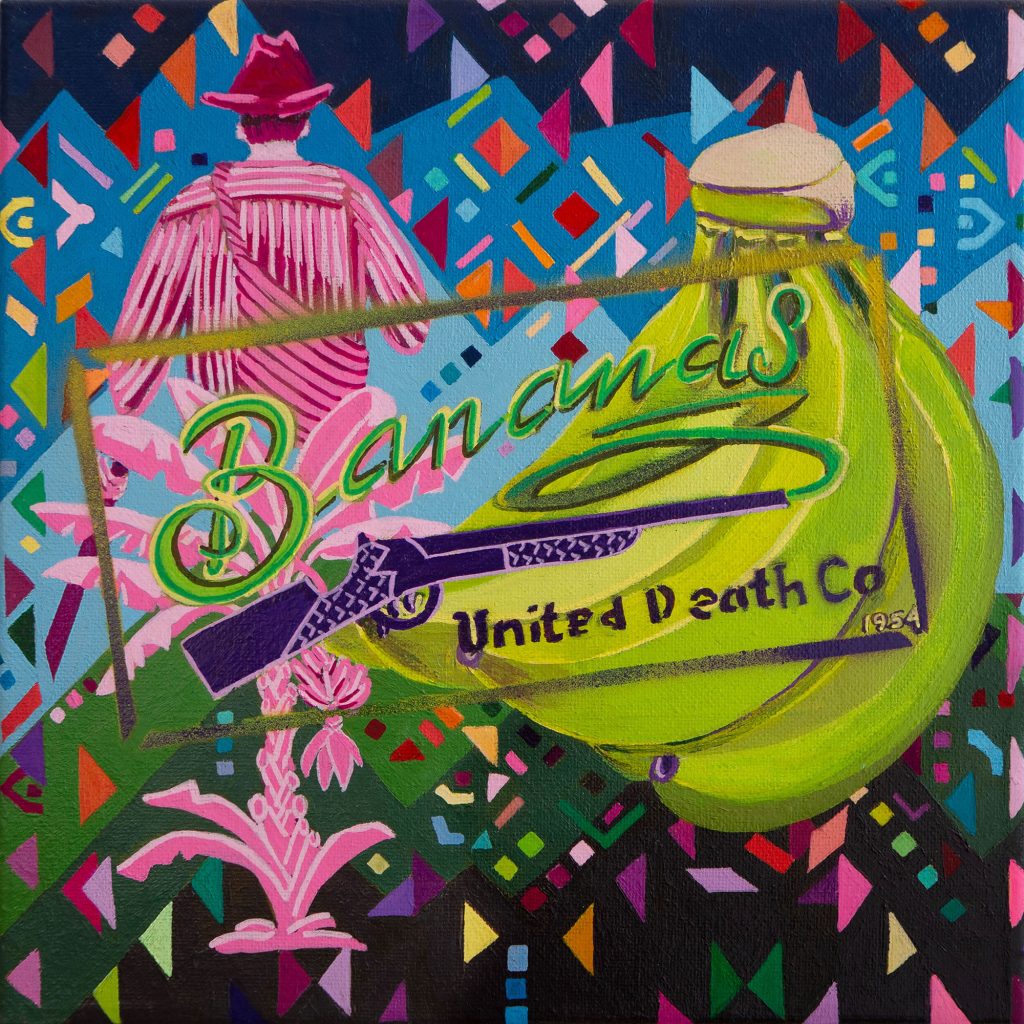
It’s Bananas, #3 (from Stencil Series – Since 1492) |
YEAR |
2025 |
ARTIST’S COUNTRY OF ORIGEN |
Guatemala, USA |
DIMENSIONS |
25.4 x 25.4 cm / 10 x 10 " |
MEDIUM |
Acrylic spray-paint, acrylic paint and acrylic markers |
Courtesy of the Artist
Karen “Karne” Vera’s It’s Bananas, #3 (from Stencil Series – Since 1492) (2025) and Cruel Summer, #5 (2024) deploy bold color, stencil work, and Indigenous textile geometries to map the long arc of colonial violence in Central America. In these compact yet visually dense compositions, the banana becomes both subject and historical trigger—an entry point into centuries of extractive practices that stretch from Columbus’s arrival in 1492 to the Cold War interventions that reshaped Guatemala. Vera’s reimagined United Fruit Company logo in It’s Bananas, #3, complete with an embedded rifle and the pointed renaming “United Death Co,” underscores the lethal entanglement of U.S. corporate interests, military force, and the 1954 coup d’état. The banana’s bright green surface is thus transformed into a weaponized emblem, symbolizing how a fruit not native to the Americas came to dictate the fate of entire nations.
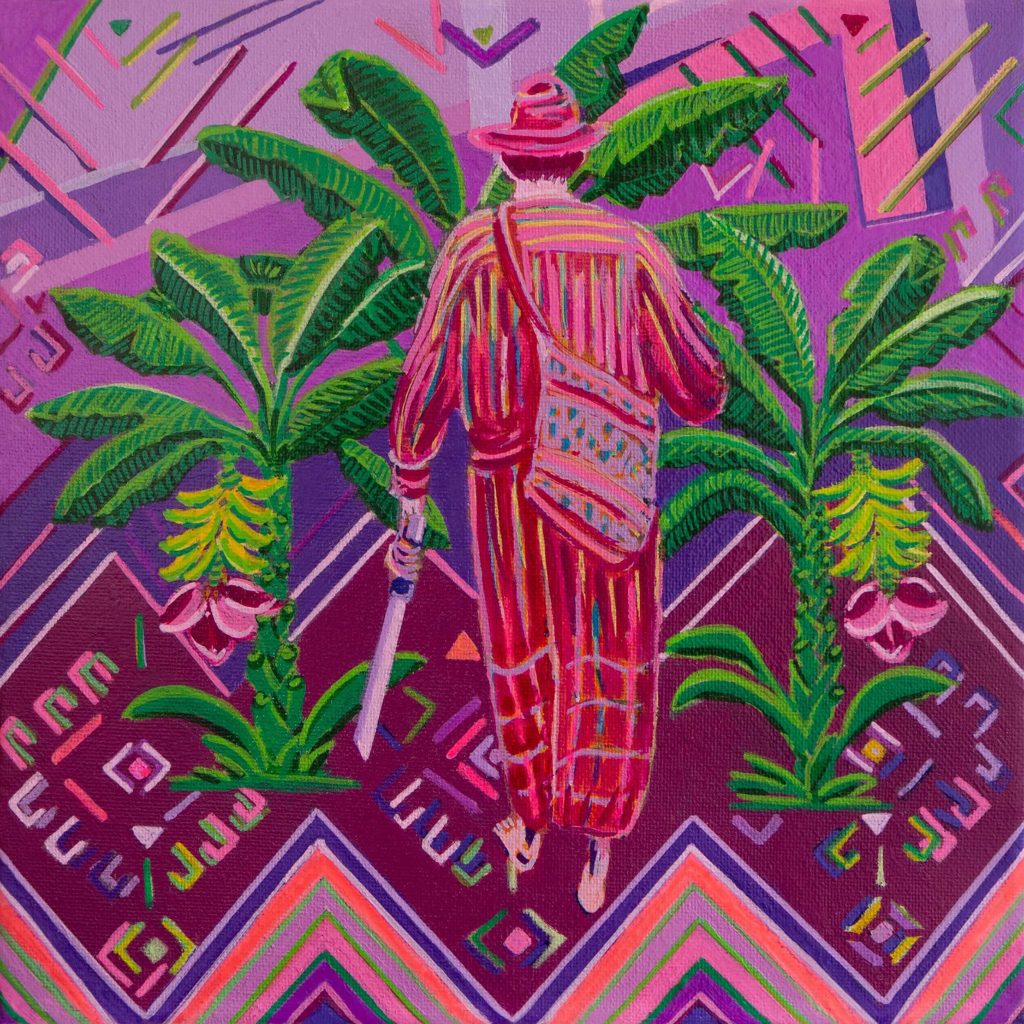
In Cruel Summer, #5, a barefoot campesino walks toward a grove of banana trees set against a fractured landscape of layered, ruptured patterns. This figure, rendered with tenderness and clarity, appears almost dislocated from the terrain behind him—a visual metaphor for the profound disruptions caused by plantation economies and forced migration. The banana grove he approaches stands as an imported crop whose global demand reshaped land distribution, labor conditions, and the political destinies of Central American communities. Through her use of stencils, pattern ruptures, and sharp chromatic contrasts, Vera highlights the structural disconnect between Indigenous lifeways and the ecological impositions of colonial capitalism. The painting becomes an allegory of disorientation—of workers caught between ancestral land and foreign crops, between continuity and displacement.
Across both works, Vera integrates geometric motifs derived from Central American textiles, yet intentionally leaves them incomplete or fragmented to signal the interruptions of diasporic identity. These patterns act as visual echoes of languages and histories partially lost through colonization, civil war, and migration. By situating the banana at the center of these narratives—sometimes as icon, sometimes as accusation—Vera anchors her critique in the fruit’s dual role as both everyday sustenance and colonial instrument. The result is a vivid, multi-layered reflection on how personal and collective identity is shaped by political trauma, ancestral memory, and the long shadow cast by an industry that remade the region’s landscape, economy, and imaginaries.
