


ARTIST |
Julia Santos Salomon |
TITLE |
Puente de plátanos |
YEAR |
1998 |
ARTIST’S COUNTRY OF ORIGEN |
Dominican Republic, USA |
DIMENSIONS |
60.96 x 46.36 cm / 24 x 18.25 " |
MEDIUM |
Silkscreen |
Courtesy of the artist
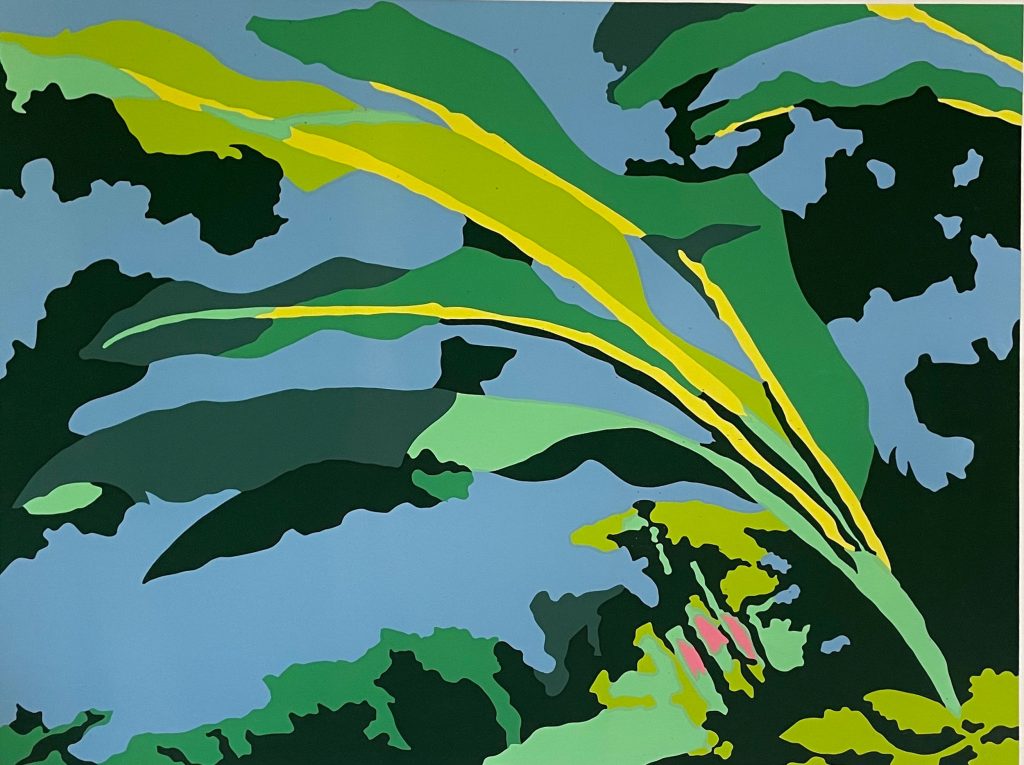
Julia Santos Salomon’s Puente de Plátanos (1988) transforms the familiar plantain leaf into a sweeping, abstract topography. Rendered through hand-pulled silkscreen, the composition fractures the leaf’s architecture into bold, interlocking planes of green, blue, and yellow. The plantain—one of the most essential crops in the Dominican Republic, present in backyards as much as in plantations—becomes here a bridge between observation and memory. Rather than presenting the fruit or the tree as icon, Santos Salomon turns to the leaf’s structural drama: its long blades, split from edge to spine, catching and refracting light as they move in the wind. The result is a visual field that oscillates between the botanical and the atmospheric, rooted in the physicality of a plant that sustains everyday life.
The work emerges from the artist’s return to the Dominican Republic in the 1980s, when she sought to re-encounter the landscape of her childhood after years in the United States. In her own words, the shifting tones on a single leaf and the way its sections “swayed in different directions” became a source of fascination—an interplay of stability and movement that resonated with her own bicultural identity. Originally painted in oil with softer hues, the image was later translated into silkscreen, its graphic composition sharpened through individually pulled screens and hand-cut films. Santos Salomon introduced a new element in this 1988 version: vibrant pink accents, borrowed from the announcement of her daughter’s birth. These small, bright marks operate both as aesthetic punctuation and as an intimate gesture, weaving personal history into the surface of the print.
Puente de Plátanos thus occupies a compelling position within the broader Banana Craze archive. While deeply personal, the work speaks to the larger cultural and emotional charge carried by the plantain in Caribbean life—not only as sustenance, but as a vessel for memory, belonging, and the act of looking. As in other pieces by Santos Salomon, the landscape becomes a mirror for self-understanding: “I am in the landscape and the landscape is in me,” she writes. Through this interplay of abstraction, observation, and inheritance, the artist invites viewers to consider their own relationships to place and origin, and to reflect on the everyday vegetal forms that anchor those stories.
