


ARTIST |
Karen “Karne” Vera |
TITLE |
United Death Company. Sorry, I meant United Fruit Company |
YEAR |
2025 |
ARTIST’S COUNTRY OF ORIGEN |
Guatemala, USA |
DIMENSIONS |
86.36 x 101.6 cm / 34 x 40 " |
MEDIUM |
Oil on canvas |
Courtesy of the Artist
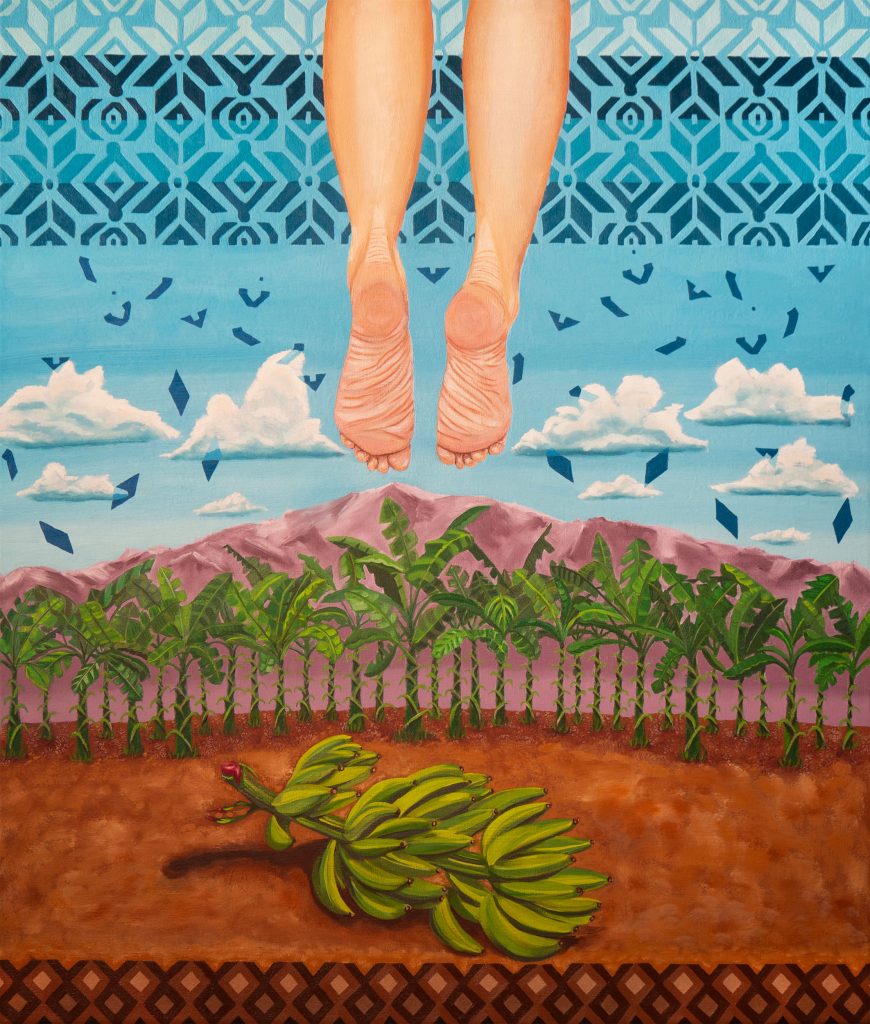
Karen “Karne” Vera’s United Death Company (2025). Sorry, I Meant United Fruit Company (2025) confronts the violent entanglement between U.S. imperial interests and Guatemala’s political history. A bunch of fallen bananas lies on taut, reddish soil, rendered with the tenderness of still life yet shadowed by a grim undertone: the fruit appears both ripe and discarded, a reminder of how something so seemingly benign fueled enormous devastation. Above this scene float a pair of suspended feet—ambiguous, ungrounded, hovering between ascent and execution. Together with the distant mountain range and the rows of banana plants, the composition presents a landscape that is both familiar and haunted, one where the legacies of the United Fruit Company linger like unresolved ghosts.
The painting names its subject plainly: the 1954 CIA-backed coup that ousted President Jacobo Árbenz to protect United Fruit’s holdings, destabilizing Guatemala for decades and contributing to a civil war marked by state terror and genocide. Vera’s title pivots from satire to indictment, underlining how corporate power, colonial extraction, and political manipulation converged around a fruit not native to the region—a crop imposed, industrialized, and weaponized. The bananas thus function as more than an agricultural motif; they stand as witnesses to the violence that reshaped the nation, and as symbols of the intimate scale at which imperialism enters daily life, from fields to kitchens to multigenerational trauma.
Bordering the composition, Vera incorporates patterns derived from Guatemalan textiles—motifs tied to Indigenous knowledge systems and forms of communication she describes as part of a heritage ruptured by diaspora. Born in the United States with limited access to family and cultural continuity, the artist reclaims these designs as a visual language through which to process fragmented ancestry. Their presence in the work sutures personal identity to national history, creating a space where ancestral patterning, political memory, and diasporic self-fashioning meet. In this interwoven narrative, the fallen banana emerges not just as evidence of exploitation but also as an entry point into the complex process of cultural recovery, allowing Vera to articulate both the losses of the past and the possibility of reclaiming what remains.
