


ARTIST |
Baquerizo-Racines Francisco |
TITLE |
Sin Título (Pan, Techo y Empleo) |
YEAR |
2020 |
ARTIST’S COUNTRY OF ORIGEN |
Ecuador |
DIMENSIONS |
30 x 20 cm / 11.81 x 7.87 " |
MEDIUM |
Mixed media on carton |
Courtesy of the artist
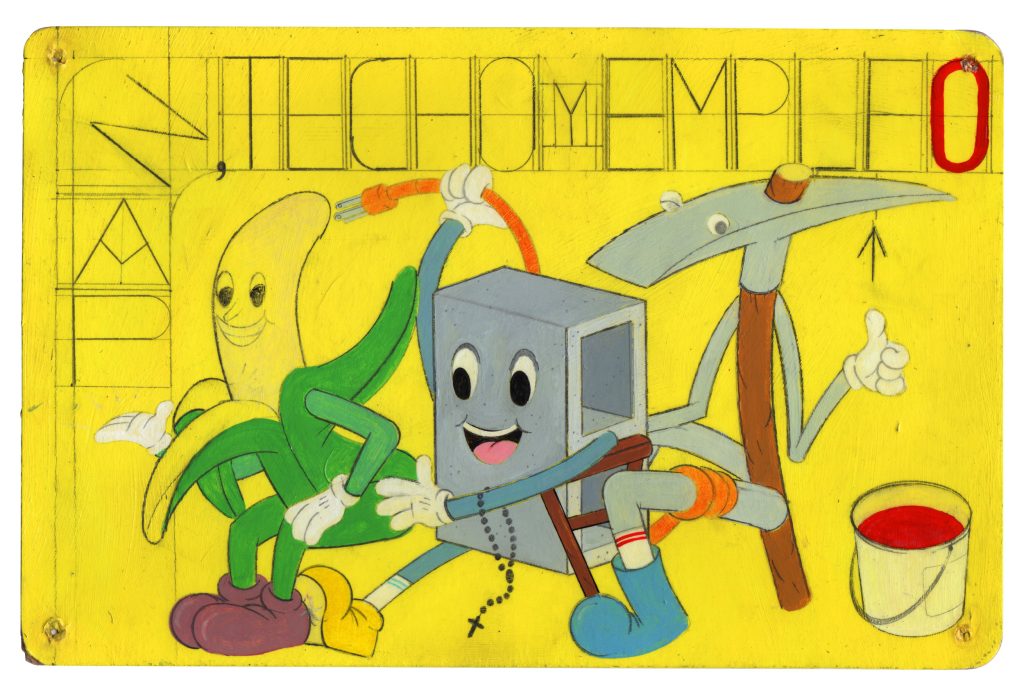
Francisco Baquerizo Racines’s Sin Título (Pan, Techo y Empleo) (2020) transforms the familiar language of propaganda into a surreal tableau of cartoon allegory and political critique. Painted on humble cardboard in bright, saturated tones, the piece reanimates the populist slogan “Pan, Techo y Empleo” (“Bread, Roof, and Employment”)—a phrase popularized by Ecuador’s right-wing politics since the 1980s—through three anthropomorphic figures: a smiling banana, a cheerful concrete block, and a pickaxe mid-stride. Together they parody the promise of prosperity and stability, marching optimistically under the guise of progress even as the country, on the eve of new elections, faced the social and economic collapse exacerbated by the pandemic.
By adopting the visual idiom of mid-century animation—round eyes, soft outlines, buoyant gestures—Baquerizo channels the aesthetics of Disney and Western mass media that have permeated Ecuadorian popular culture since the 1990s. The result is a biting irony: forms associated with innocence and consumption are repurposed to expose manipulation and dependency. The banana, in particular, serves as a polyvalent symbol: a stand-in for sustenance, a metonym of Ecuador’s export economy, and an emblem of political complicity. In its smiling form, one might glimpse the shadow of the country’s banana magnates—whose influence has long bridged the gap between corporate empire and state power.
Sin Título (Pan, Techo y Empleo) situates the banana at the heart of Ecuador’s national mythology, where nourishment, labor, and exploitation intertwine. The fruit—depicted as both vital and caricatural—embodies the paradox of a nation that consumes what it exports yet remains beholden to the structures of global capital that the banana trade represents. By rendering this in cartoon form, Baquerizo exposes the farce of political rhetoric, inviting viewers to see how easily ideology, like animation, can turn violence into spectacle and dependency into a smile.
