


ARTIST |
Chisco Valdés |
TITLE |
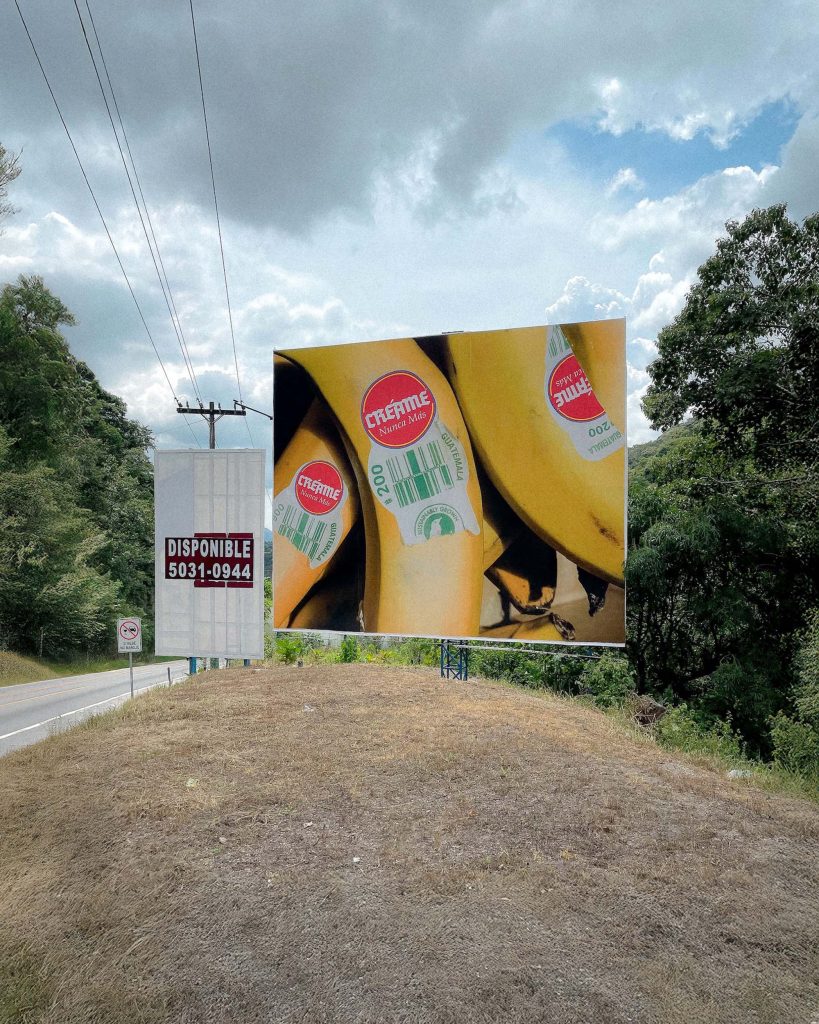
Créame Nunca Más I |
YEAR |
2021 |
ARTIST’S COUNTRY OF ORIGEN |
Guatemala |
DIMENSIONS |
345 x 620 cm / 135.83 x 244.09 ". Location of work: Km 36.5, Highway to Antigua Guatemala, Guatemala |
MEDIUM |
Digital printing on vinyl canvas over advertising metal structure |
Courtesy of the Artist. Production and assembly: La Nueva Fábrica
Chisco Valdés’s Créame Nunca Más I (2021) transforms the language of advertising into a vehicle for historical reckoning. Installed along Guatemala’s highway to Antigua during the bicentennial celebration of national independence, the large-scale billboard replaces commercial imagery with a close-up of bananas marked by a redesigned sticker reading “Créame Nunca Más.” The familiar color scheme and typography of the multinational fruit company are maintained, yet their message is inverted—from selling “quality” to proclaiming disbelief and refusal. By occupying a structure normally dedicated to corporate promotion, Valdés reclaims a public visual field that has long served economic colonialism, confronting drivers with a stark question about what independence means when the symbols of dependency remain.
The work’s genesis lies in an intimate, almost accidental encounter: while living in the United States during the COVID-19 pandemic, Valdés received a banana stamped “Product of Guatemala” from a food bank. The sticker triggered both personal and historical memories—of his family’s distance, of laborers’ hunger in a land of abundance, and of the United Fruit Company’s century-long tax exemptions and political interference. Through this recognition of dissonance, Créame Nunca Más I emerged as a gesture of reclamation. By overlaying the logo with the words once used in testimonies from the Recovery of Historical Memory Report—“Créame” (Believe me) and “Nunca Más” (Never again)—Valdés merges personal trauma with collective memory, turning the fruit label into a mnemonic device against historical amnesia.
Beyond its visual economy, the piece functions as a call for social reconstruction. Its resonance extends from the material history of the banana to the ethical imperative of remembrance articulated in Guatemala’s 1998 REMHI Report: “Clarifying and explaining—as far as possible—what happened... constitutes the basis for a process of social reconstruction.” Valdés’s intervention does precisely that. By subverting a logo that once symbolized exploitation, he stages a counter-advertisement for accountability—transforming a site of commercial spectacle into a billboard for critical memory and collective dignity.
