


ARTIST |
Eddy Leonel Aldana |
TITLE |
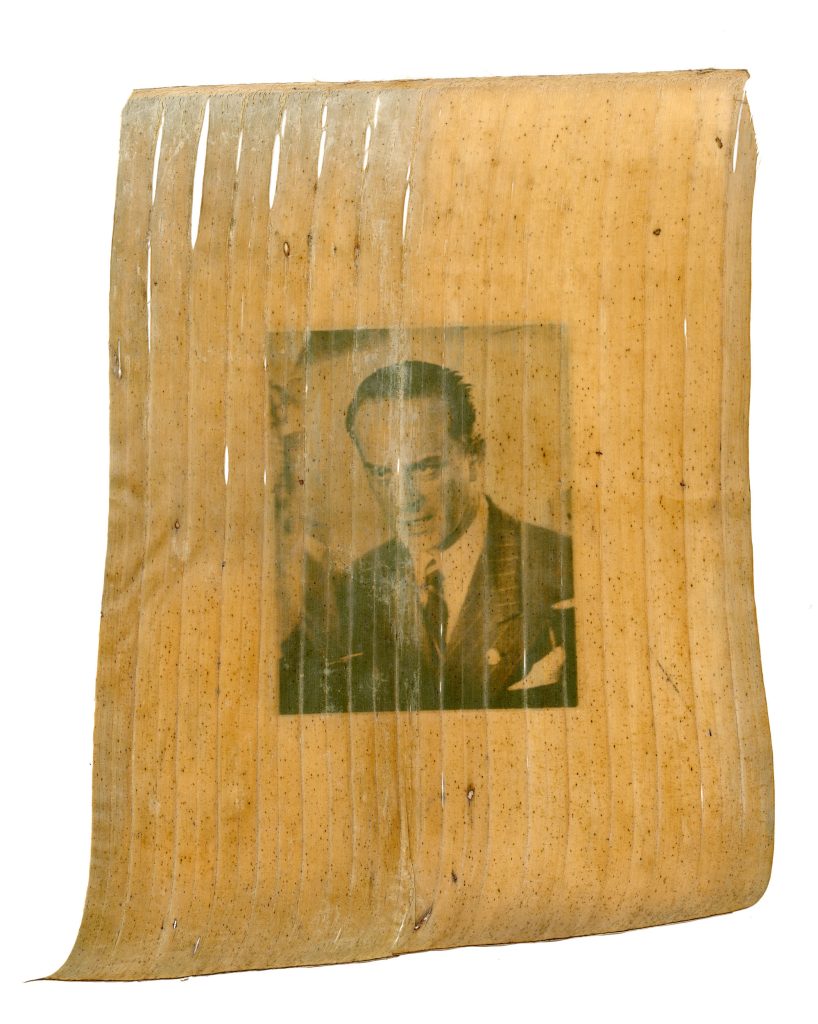
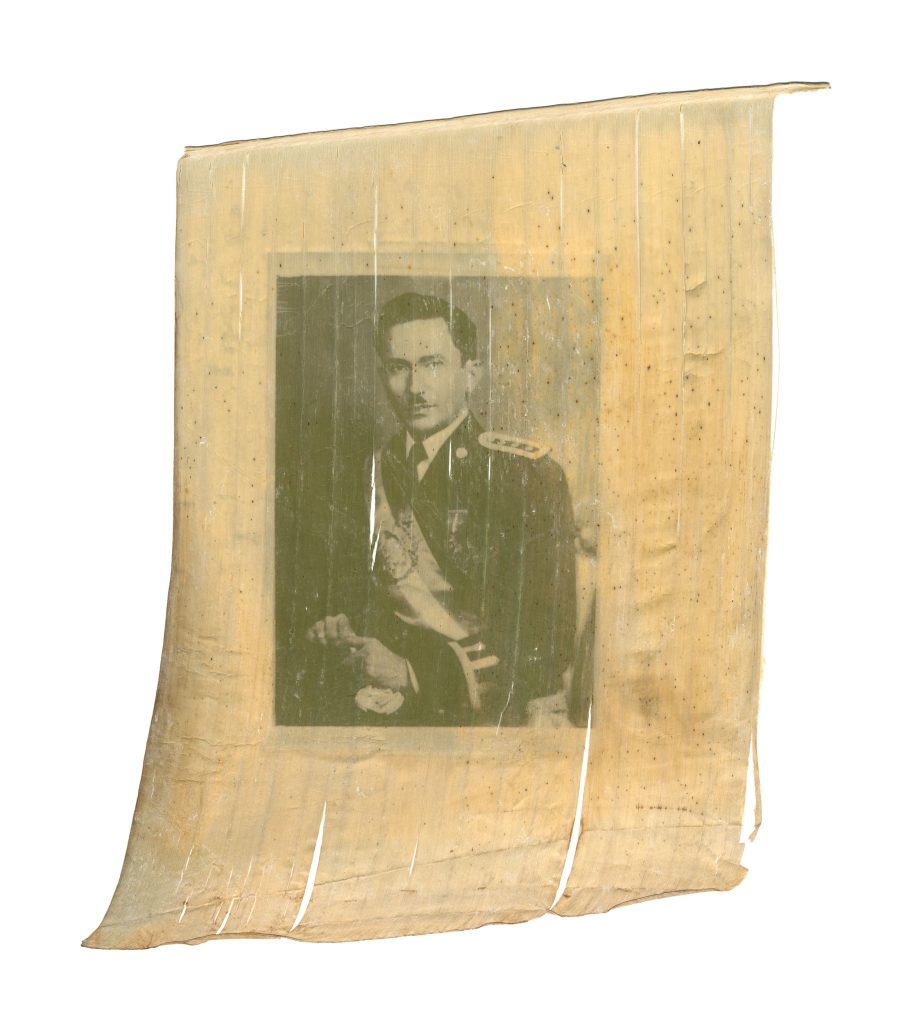
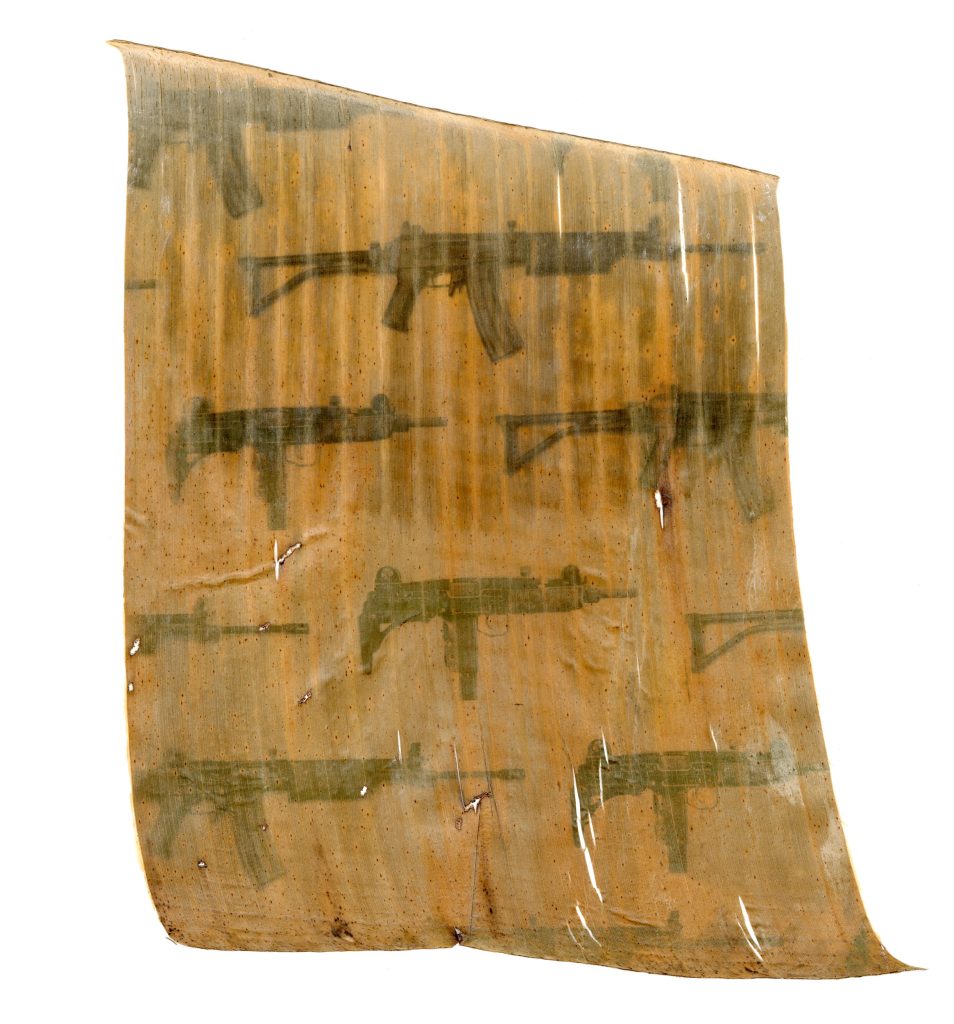
El Pueblo no Se Olvida. This series contains three works: Unconditional Support of Genocide (Galil and Uzi) | Consequences of a Coup d’Etat (Carlos Castillo Armas) | Overthrowing a President in the Interest of Multinational Corporations (Jacopo Arbenz) |
YEAR |
2025 |
ARTIST’S COUNTRY OF ORIGEN |
Guatemala, USA |
DIMENSIONS |
In order of titles mentioned: 24.13 x 27.31 cm / 9.5 x 10.75 ". 26.04 x 32.39 cm / 10.25 x 12.75 ". 25.4 x 31.12 cm / 10 x 12.25 |
MEDIUM |
Banana Leaf Chlorophyll Print |
Courtesy of the Artist
In El Pueblo no Se Olvida (2025) (The People Will Never Forget), Eddy Leonel Aldana imprints Guatemala’s silenced histories onto the living surface of banana leaves. Using chlorophyll printing—a process in which sunlight bleaches an image into organic matter—the artist transfers archival photographs of weapons, dictators, and political figures directly onto the plant that once fueled the nation’s subjugation. The resulting images, ghostly and fading, recall both the fragility of memory and the endurance of trauma. As the banana leaves slowly deteriorate, they mirror the instability of historical truth when left unprotected by collective remembrance.
Each print revisits a distinct chapter in Guatemala’s twentieth-century history: the U.S.-backed overthrow of President Jacobo Árbenz in 1954, the ensuing dictatorship of Carlos Castillo Armas, and the decades of civil conflict sustained by global arms trades and corporate interests. By materializing these events on banana leaves—the very crop tied to the United Fruit Company’s imperial reach—Aldana exposes how colonialism and capitalism entwined to reshape the region’s political and ecological landscapes. The chlorophyll becomes both medium and metaphor: what remains green resists erasure, while what burns away testifies to the violence of forgetting.
Through this act of imprinting, Aldana transforms documentation into an embodied ritual of remembrance. His process literalizes the idea that history lives in the land itself: in the scars of extraction, in the soil that fed the plantations, and in the leaves that now carry the faces of those who enforced or resisted domination. El Pueblo no Se Olvida confronts revisionist narratives by letting the medium—organic, unstable, and mortal—speak to the endurance of collective memory. In doing so, Aldana turns the banana leaf into both archive and witness, ensuring that what the earth has seen will not fade without resistance.
