
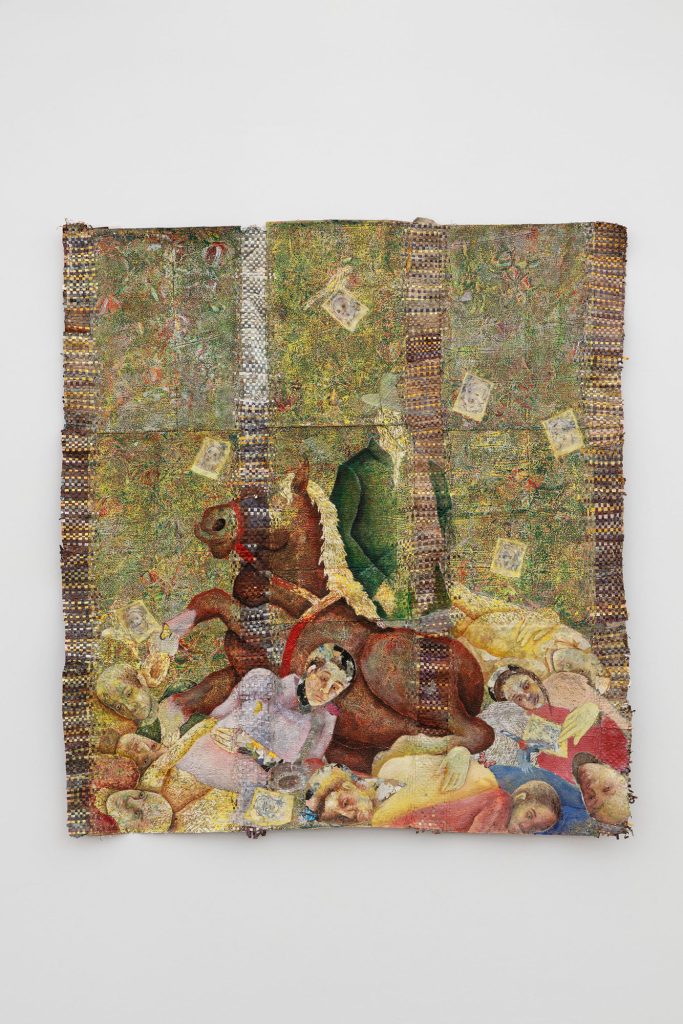


ARTIST |
Kathia St. Hilaire |
TITLE |
Mamita Yunai |
YEAR |
2023 |
ARTIST’S COUNTRY OF ORIGEN |
Haiti, USA |
DIMENSIONS |
180.3 x 167.6 cm / 71 x 66 " |
MEDIUM |
Oil based relief on canvas collage with skin lightening cream, steel, aluminium, banknotes, price tags, banana stickers, silkscreen, and tires |
Courtesy of the Artist and Perrotin. Photographer: Guillaume Ziccarelli
Kathia St. Hilaire’s Mamita Yunai (2023) transforms a pivotal chapter of hemispheric banana history—the brutal suppression of plantation strikes across Central and South America—into a densely layered meditation on resistance, memory, and the material legacies of empire. Taking its title from Carlos Luis Fallas’s semi-autobiographical novel about working conditions under the United Fruit Company, the piece foregrounds nine intertwined bodies whose forms echo the nine demands made by Costa Rican and Colombian banana workers in 1928. St. Hilaire renders them not as inert casualties, but as figures suspended in a liminal state between death, rest, and revolutionary continuation. Their bodies fold beneath a collapsed horse and a rain of commemorative leaflets, creating an atmosphere that is simultaneously mournful and incantatory—an invocation of the “marvelous real” that Carpentier identified as intrinsic to Latin America’s historical experience.
Throughout the work, bananas become the gravitational core that binds these histories across geographies. Price tags and Chiquita stickers punctuate the surface; green fronds and plantain forms emerge beneath the relief-printed textures; and the faint logic of plantation infrastructure—labor regimens, export rhythms, corporate extraction—shapes the composition from within. St. Hilaire positions the banana not simply as a crop but as a structural force: a commodity whose global demand drove coerced labor, territorial rearrangements, and U.S. military intervention from the Caribbean to the Andes. The painting’s woven vertical bands, reminiscent simultaneously of currency security threads and government redactions, hint at the economic and political systems that concealed, justified, or sanitized these violences. In Mamita Yunai, the banana becomes a cipher for the entanglement of imperial capital and the erasure of working-class lives.
St. Hilaire’s material vocabulary deepens this critique. Skin-lightening cream packaging, banknotes, aluminum, tires, and silkscreened fragments circulate across the surface like strata of personal and collective memory. These elements evoke the cosmetic, economic, and infrastructural pressures shaping Afro-diasporic life in the Americas—pressures born from the same colonial extractive logics that once governed banana enclaves. Hints of Vodou cosmology pulse through the scene: the bodies appear almost ridden by spirits, their stillness charged with potential, as though revolution persists through them. By merging magical-realist sensibility with the political histories of the banana zone, St. Hilaire offers a panoramic, transnational vision of resistance—one that recognizes banana workers not only as victims of imperial violence but as agents whose struggles reverberate across generations.
