


ARTIST |
Jackie Amezquita |
TITLE |
Los cuerpos de América Latina |
YEAR |
2023 |
ARTIST’S COUNTRY OF ORIGEN |
Guatemala |
DIMENSIONS |
243.84 x 27.94 cm / 96 x 11 " |
MEDIUM |
Bananos y sal incubados en cobre durante un periodo de cinco meses |
Cortesía de la artista
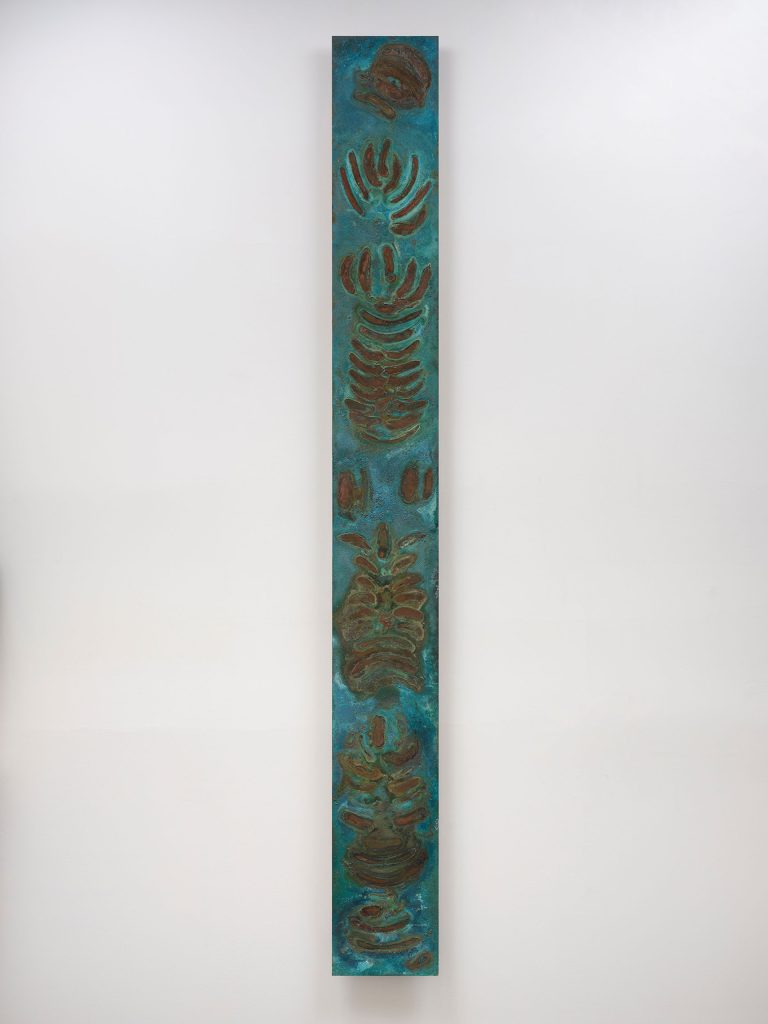
In Los cuerpos de América Latina (2023), Jackie Amézquita extends her alchemical engagement with biomaterials, using bananas and salt incubated on copper for five months to generate a columnar composition that reads as both corporeal and cartographic. As the fruit decomposes, its chemical interaction with the metal produces blues, greens, and rusted browns that resemble bruised skin, oxidized landscapes, or archaeological strata. The banana forms, once recognizable, dissolve into layered traces—an indexical record of decay that echoes the long histories of labor, extraction, and displacement inscribed onto Latin American bodies and territories. This materially driven mark-making is consistent with Amézquita’s practice, in which decomposition is not aesthetic metaphor alone but an active agent shaping the work.
Like the copper triptych el SUDOR de mi GENTE (2023), this piece harnesses the unpredictable processes of rot, deliquescence, and infestation to foreground how movement—of insects, moisture, matter—creates intermingled residues across surfaces. Amézquita has described this cross-pollination as analogous to the migratory flows that have shaped the Americas, where bodies move through systems of precarity and survival, leaving behind subtle but enduring traces of “labor, life, and death.” The vertical format intensifies this reading: the panel becomes a kind of spine, a corporeal axis along which histories accumulate, fracture, and sediment.
Materially, the work operates within Amézquita’s broader cosmology, rooted in Mesoamerican understandings of transformation, ritual, and the cyclical relationship between creation and decay. In her recent exhibition, the artist’s copper pieces were described as evoking both bodies and landscapes—sites shaped by extractive economies and colonial infrastructures. Los cuerpos de América Latina crystallizes this duality. It invites viewers to read decomposition as a form of testimony, where the organic imprint of fruit stands for the enduring imprints of migration, resistance, and survivance across the Latin American continent.
